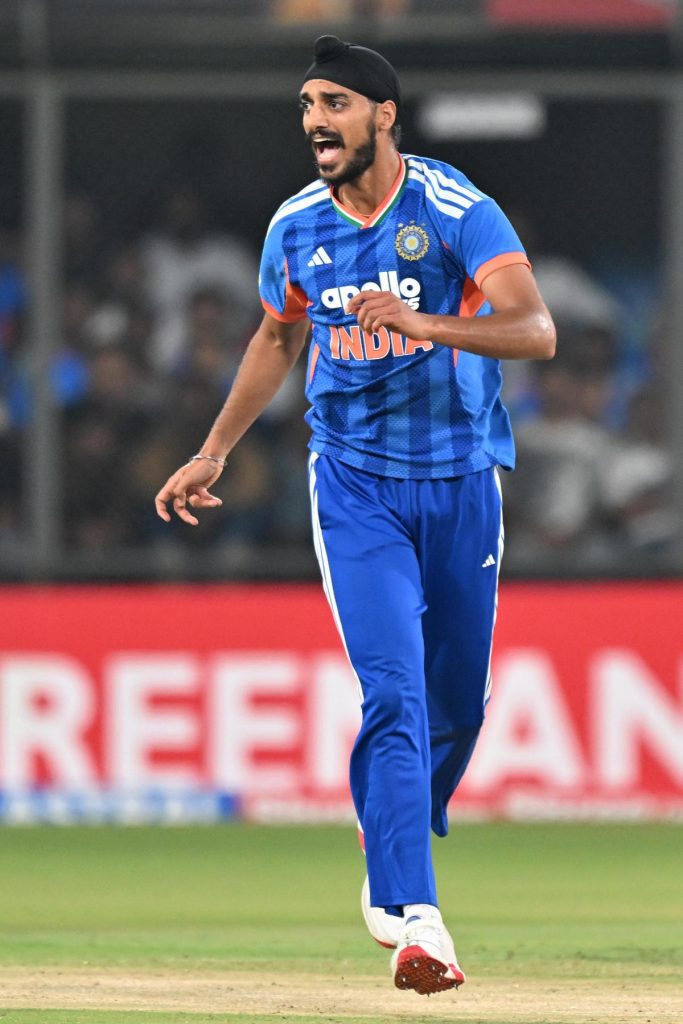
Arshdeep. | Photo Credit: K.R. DEEPAK
Campbell, red-hot skipper Shai Hope and the impressive Amir Jangoo provided the first instance of three batters slamming hundreds in the same ODI innings, propelling West Indies to 405 for seven. That’s more than eight runs an over for 50 overs, an extraordinary accomplishment that would guarantee victory 999 times out of 1,000. Because they knew that even a run-rate of 8.10 didn’t hold any guarantee, only once before, a decade back, had a larger score been hunted down (by South Africa against Australia) internationally, so West Indies would have entertained some designs of squaring the series, but only some designs.

West Indies had never scored that many to win a match, and at various stages, it seemed as if they wouldn’t again, but their skipper didn’t buy into that theory. Hobbling and wincing, he found a second wind to batter India into submission, raising victory with ten deliveries to spare. Over to Ranchi, and game two. Remarkably.
Having kept wickets for 50 wickets and picked up a groin twitch along the way, he made the most of a fortuitous promotion as opener – where he has tasted unparalleled ODI success – with an innings for the ages. Sanju Samson, that infuriatingly inconsistent opener who oscillates between the dreamy and the nightmarish with frustrating frequency, shed a lean trot with a blazing 82, and the captain and his deputy, Tilak Varma, produced an exhilarating final kick to propel India to 249 for five. It was worth more than West Indies’ 405 in the second ODI in all ways imaginable, yet it proved remarkably inadequate.
India’s 14-run victory in Sunday’s third Twenty20 International had to be earned the hard way, but at least it provided some solace to a fraternity that has been on a hiding to nothing since West Indies’ snappy white-ball tour of India began in Thiruvananthapuram on September 27. India plucked out Kamil Pooran – no relation to the more celebrated Nicholas – and Shimron Hetmyer off successive deliveries through the express Mayank Yadav in the very first over, and when Mayank also cleaned up Rovman Powell, West Indies were up against it at 58 for three. They both teed off, the left-handed Rutherford and his right-handed captain matching each other blow for pulverising blow while adding 120. That they reached 252 with nine deliveries to spare amply demonstrated the dominance of the bat over the ball, which is why India’s 14-run win in Indore assumes greater significance even though they had an impressive 223 to defend. At the interval, the pundits were busy dissecting if 223 was enough. More than 11 runs an over, and the experts are debating if the team batting first was a few short. The Aussie great then held forth on the virtues of defensive bowling, reiterating that especially in 20-over cricket, it is not always imperative to go looking for wickets every ball.
At practice, they often use wet, slippery balls to try and replicate the conditions they will most likely be confronted with in a match situation, but the nets does not entail the same pressure to deliver as a match, and therefore no amount of training can translate to perfecting a most difficult craft. Not till the sixth outing in a cluster of eight did a team batting first finally manage to successfully defend a total. It’s not as if bowlers don’t account, or prepare, for this scenario. Hope – who else? – and Sherfane Rutherford pushed back spectacularly. There was no time to rebuild, no point in steadying the rocking boat. Rutherford missed out on a century but Hope wasn’t to be denied, powering his team past the finish line with Romario Shepherd for company. It was the second time in three matches (and two different formats) that West Indies had completed a record chase. Imagine that. Where are we headed? Is this how it is going to be, with towering edifices erected in the evening and razed to the ground by night? Will game after game follow a monotonous pattern of ball-bashing, aided by flat decks, small boundaries, light bats with extended sweet spots, and a profusion of power and cheekiness that leave bowlers tearing their hair out in frustration? “You can just see a player almost melt out there in the middle, they just cannot find the gap, cannot find the boundary. I feel like that’s the biggest pressure in the game now, it almost releases the pressure (on the bowlers) a little bit.”
There is much to be said of the advantages of chasing in India at this time of the year, when the dew is quite pronounced and gripping the ball in the second half of a match, especially for the spinners, is practically impossible. “If you can get a batter on two off six balls, the pressure that they’re under in that situation is huge,” he pointed out.